
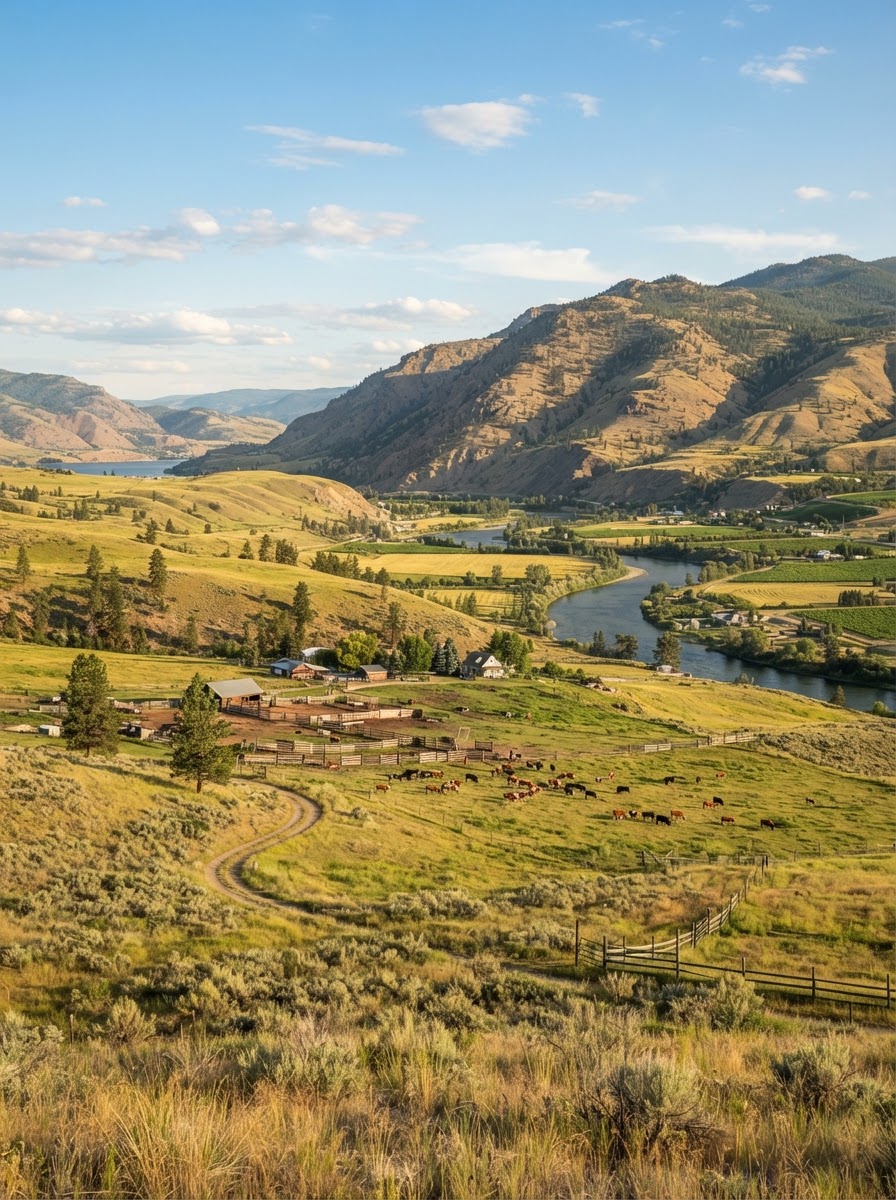
Ranches & Cattle Properties for Sale in Kamloops
Kamloops is the centre of BC's Thompson ranching country, where cattle and forage operations combine deeded land, hay production and Crown grazing tenure. Buying a Kamloops ranch means verifying water for livestock, the status and transferability of grazing tenure, and the productive forage base — large acreage is not the same as productive acreage.
Why Kamloops
Ranches & Cattle in Kamloops
Kamloops' dry Interior grasslands, benchland forage and Crown range access make it the hub of Thompson cattle country, with the largest cluster of operating ranches and grazing tenure in the BC Interior.
What to Know Before Buying
Kamloops ranches operate in the dry Interior grasslands of the Thompson region, where cattle and forage operations combine deeded land, hay production and Crown grazing tenure. The dry climate makes water the key constraint — a large deeded acreage is worth little without secure stock water and irrigation for the forage base. Productivity is measured by carrying capacity, not by total acreage on paper.
Crown grazing tenure is central to most Kamloops ranches, and the specific range matters. Tenure on the Lac du Bois grasslands above the city, the Campbell Creek range to the east, and the Deadman's Creek valley to the northwest each carries different forage types, elevation bands and season-of-use terms. Grazing agreements — range use permits and grazing leases — are administered separately from the deeded land and are not automatically guaranteed to transfer. A buyer should confirm the status, terms and transferability of any grazing tenure with the provincial range program before relying on it as part of the purchase.
Ranch value lies in the forage base and water infrastructure, not in raw acreage. Buyers should assess productive versus total acreage, irrigated hay land along the Thompson and North Thompson river benches, soil capability, fencing, corrals, barns and year-round road access. ALR status matters too — ranch parcels are often large and further subdivision is tightly restricted by the Agricultural Land Commission.
Thompson-Shuswap Farmland Market Context
Sourced regional market data for Kamloops and the broader Thompson-Shuswap region. Actual parcel values depend on soil class, water rights, improvements and current market — this is a typical range, not an appraisal.
$8,000 – $35,000 / acre (irrigated benchland)
Value strongly depends on water licence volume and irrigation infrastructure attached to river benches.
Cattle Ranching, Forage & Alfalfa, Ginseng, Tree Fruit (Salmon Arm)
Thompson & Shuswap River licences, groundwater wells, storage reservoirs
CLI Class 3 – 5 (Alluvial valley bottoms to rolling range land)
Source: BC Ministry of Agriculture & StatsCan Census of Agriculture 2021 (2021–2025). Regional per-acre range is a BuyBCFarms.ca market analysis informed by Statistics Canada and Farm Credit Canada data; sub-regional dollar bands are our editorial estimate, not a figure published by those sources.
Due Diligence Checklist
- Verify licensed water sources, wells and any range-water access — water is the key constraint on Interior ranchland.
- Confirm the status, terms and transferability of any Crown grazing tenure with the provincial range program.
- Assess productive versus total acreage — the forage base and carrying capacity, not paper acreage.
- Evaluate irrigated hay land, soil capability and the condition of fencing, corrals and barns.
- Confirm year-round road access and proximity to markets, auction yards and supplies.
- Check ALR status and whether subdivision is permitted.
- Review any easements, rights of way or water-district obligations.
What Drives Value
Illustrative guidance only — actual value depends on the specific parcel, its condition, water, soil and current market. Not a formal valuation.
Frequently Asked Questions
Does Crown grazing tenure transfer with a Kamloops ranch sale?
Crown grazing agreements (range use permits and grazing leases) are administered separately from the deeded land and are not automatically guaranteed to transfer. A buyer should confirm the status, terms and transferability of any grazing tenure with the provincial range program before relying on it as part of the purchase.
Why is water so important on a Kamloops ranch?
The dry Interior makes water the key constraint. A large deeded acreage is worth little without secure stock water and irrigation for the forage base. Verify licensed water sources, wells and any range-water access before buying — total acreage without secure water supports little.
What's the difference between deeded land and Crown grazing tenure on a Kamloops ranch?
Deeded land is privately owned and transfers with the sale. Crown grazing tenure is a government-administered agreement allowing use of Crown range, and it is separate from the deeded land. The two are distinct assets with different rights, terms and transfer rules.
How is a Kamloops ranch's productivity measured?
By the forage base and carrying capacity — how many animals the land can support — not by total acreage. Assess productive versus total acreage, soil capability, irrigated hay land and water infrastructure rather than judging value by land area alone.
Can a Kamloops ranch be subdivided?
ALR ranch parcels are often large and further subdivision is tightly restricted. Confirm ALR status and whether subdivision is permitted before buying with that expectation — fragmentation of agricultural land is controlled by the Agricultural Land Commission.
Related Resources
Looking for ranches & cattle in Kamloops?
From Kamloops ranches & cattle to other BC farm types, get expert guidance from a real estate professional who specializes in British Columbia agricultural land.