

Written by Gurjit Ghai, REALTOR®
Rexara Realty Inc.·Published: October 12, 2026·Market Insights
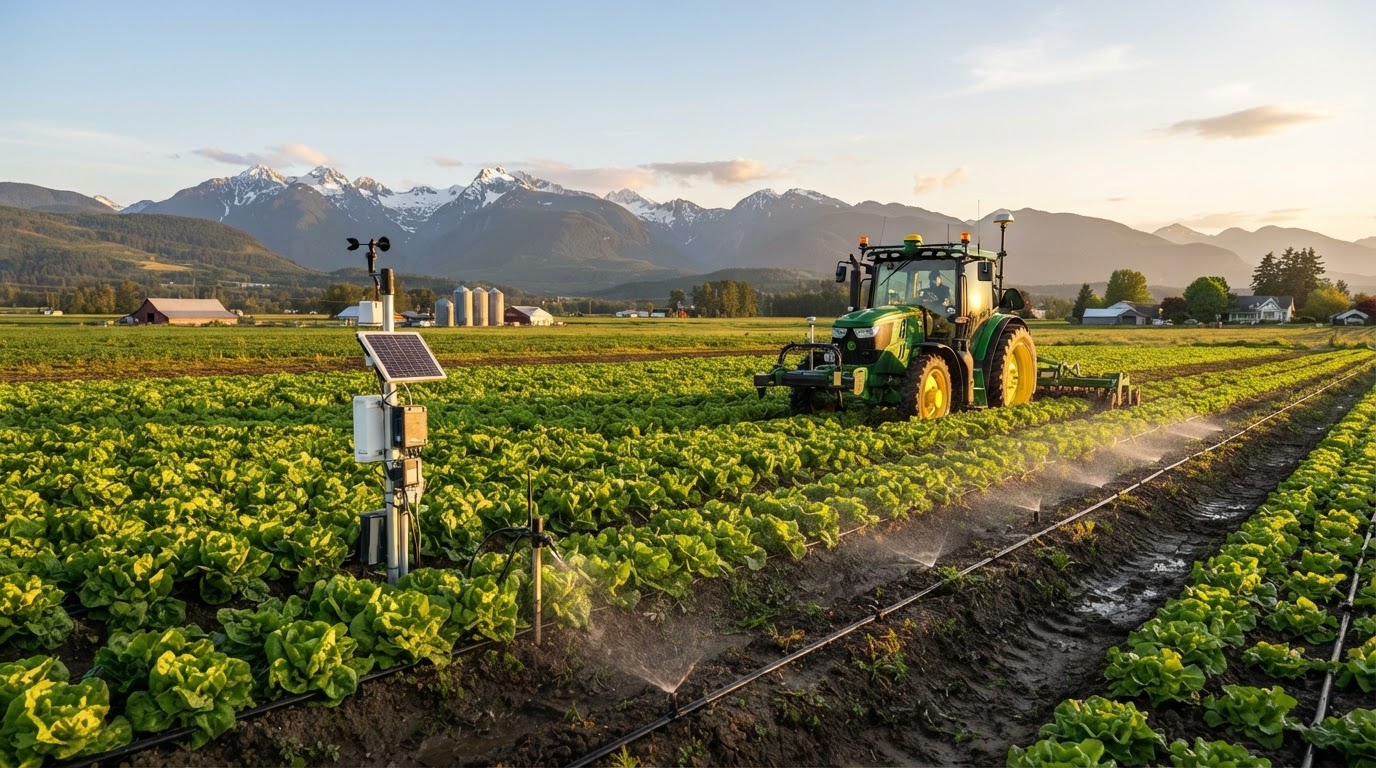
For most of the time buyers have been evaluating BC farmland, the technology on a parcel barely came up. A farm had soil, water, access, buildings and a price. That is starting to change. Precision agriculture, autonomous equipment, sensor networks and AI-driven irrigation management have moved from the experimental edge of the industry into real, installed infrastructure on working BC farms — and the same buyers who once asked only 'does it have water?' are now also asking 'does the irrigation run itself, and does that come with the land?'
This article explains what smart farming actually means on a BC parcel, how installed AgTech is beginning to factor into farmland value and due diligence, what a buyer should verify before an offer, and why the realistic answer is that the value sits in the installed systems and the infrastructure that supports them — not in a vague 'AI potential' premium. It builds on our farm valuation guide and the due diligence checklist — read those for the valuation framework and the pre-offer process; this piece connects AgTech to both.
Installed technology is infrastructure, not a magic number
The honest framing for a buyer is this: precision-agriculture technology that is physically installed, connected and working — an automated variable-rate irrigation system, soil-moisture sensor arrays, a climate-controlled greenhouse management system, a grid-connected power supply, or a fiber backbone supporting a monitoring platform — is tangible infrastructure that can be inspected, valued and transferred. 'This farm has AI' is not. Treat installed AgTech the way you treat an irrigation system or a barn: as a real asset to verify, not a buzzword to pay a premium for.
What 'smart farming' actually means on a BC parcel
Precision agriculture is a broad label that covers a range of real, installed systems. On a BC farm in 2026, the technology a buyer might actually encounter falls into a few categories — each with a concrete footprint on the land:
- Sensor networks — soil-moisture probes, temperature and humidity sensors, and weather stations installed across a parcel and wired to a monitoring platform. These tell an operator what is happening in the field in real time rather than by walking it.
- Variable-rate and automated irrigation — systems that adjust water application by zone based on sensor data or programmed schedules rather than running a uniform set. On a water-licenced parcel, this is the layer that turns a water right into efficient, measurable use.
- Autonomous and GPS-guided equipment — tractors and implements with guidance and automation features that reduce overlap and labour. These are usually owned equipment, not land fixtures, but their usefulness depends on the parcel's layout, access and field shapes.
- Drone scouting and imagery — aerial scouting used to monitor crop health, spot water stress or map variability. The hardware may or may not convey; what matters to a buyer is whether the historical data and imagery are accessible.
- Climate-controlled systems in greenhouses — environmental control systems managing temperature, humidity, lighting and irrigation in a controlled-production operation, where the technology is often the core of the asset.
The common thread is that each of these is a real, inspectable system with a power supply, wiring or wireless connection, and usually a software platform behind it. None of it is abstract. That is what makes it possible to value and verify — and it is also why a buyer should not confuse 'the farm uses smart technology' with 'the farm is worth more.'
Does AgTech raise farmland value?
The honest answer is that installed smart-farming systems can contribute to a parcel's value, but in a specific, limited way — and the mechanism is not mysterious. A working automated irrigation system, a climate-control installation in a greenhouse, or a connected sensor platform is capital infrastructure. Like any installed improvement, it either adds usable value to the operation (because it lowers operating cost, improves reliability, or makes the farm easier to run) or it does not, depending on whether it is functional, maintained, and matched to the farm's actual needs.
The value is in the installed system, not the word 'AI'
A parcel with a functioning, well-maintained precision-irrigation system and a documented sensor network is a more capable operation than an otherwise identical parcel relying on manual irrigation and guesswork — and a buyer can reasonably weigh that in the price. A parcel marketed as 'AI-ready' with nothing installed is not. The first is an asset to verify; the second is a marketing claim to discount. Value tracks what is bolted down, connected and working, not what could theoretically be added later.
Where AgTech can realistically support value is in the operational economics it changes: lower labour per acre where automation is in place, lower water cost where variable-rate irrigation reduces waste, and better yield consistency where monitoring catches problems early. For a buyer, the practical question is not 'is this a smart farm?' but 'do the installed systems actually lower the cost or improve the reliability of running this farm — and do they convey cleanly?'
What a buyer should verify before an offer
AgTech due diligence sits inside the broader due diligence process, but the technology-specific checks deserve their own focus. None of these require estimating production numbers — they are inventory, ownership and contract checks a buyer (or their advisor) can run during the conditional period.
- 1Inventory what is installed — list the sensor hardware, irrigation controllers, automation equipment, power and connectivity infrastructure, and any greenhouse climate systems physically present on the parcel. Confirm what is owned outright versus leased or financed, because leased equipment may not convey.
- 2Confirm what conveys with the sale — installed fixtures generally go with the land, but monitoring platforms, cloud accounts and software licences are often tied to the seller's account or a third-party contract. Get in writing what transfers, what does not, and what the buyer will need to re-subscribe to.
- 3Ask who owns the data — sensor readings, imagery and historical performance records are frequently held in a seller's platform account or a service contract. Historical data has real operational value for a buyer; confirm whether it transfers or whether it stays with the seller.
- 4Check service contracts and dependencies — many precision-agriculture platforms run on recurring service agreements. Review the terms, cancellation, and whether the installed hardware works standalone or only with an active subscription.
- 5Verify the supporting infrastructure — automated systems depend on reliable power and connectivity. A parcel with grid power and fiber or reliable wireless is a better host for smart-farming systems than one running on a generator and a weak signal. The infrastructure underneath the technology is part of what makes it valuable.
These checks matter for every farm type, but they weigh most heavily where the operation is technology-intensive. A greenhouse with a full climate-control installation, an irrigated vineyard running a variable-rate system, or a berry operation on sensor-monitored irrigation all carry more installed technology — and more to verify — than a dryland parcel. Match the depth of AgTech diligence to how much the farm actually depends on it.
Installed technology is an asset to inspect, not a premium to assume
Treat smart-farming systems the way you treat any other improvement: confirm they exist, that they work, that they convey, and that the infrastructure supporting them is sound — before the offer goes firm. A precision-irrigation system that transfers cleanly and runs on reliable power is a genuine asset; an 'AI-ready' label with nothing installed is not. If you are not sure how to read a service contract or assess whether installed technology conveys, that is exactly the kind of question a BC agricultural land specialist should help you answer before you commit.
What is working, and what is hype
The realistic 2026 picture is a mix. On the working side, installed sensor networks, automated irrigation, greenhouse climate control and GPS-guided equipment are genuine, inspectable systems delivering real operational value on BC farms where they have been adopted. Labour pressure and water-management tightening have made the economics behind that adoption more compelling, not less. On the hype side, 'AI' and 'smart farm' are marketing labels that get applied loosely — sometimes to installed, valuable systems, and sometimes to nothing more than a website dashboard. The buyer's job is to tell the two apart, and the way to do that is the same as for any other asset: look at what is actually there.
The long-term direction is clearer than any single parcel's marketing. As precision agriculture moves from the edge toward the mainstream, the farms that carry functional, well-maintained, conveyable technology — supported by reliable power, connectivity and water infrastructure — are the ones where AgTech genuinely supports value. Farms where the label outpaces the installation are the ones where a buyer should discount, not pay up.
What this means for a buyer
For a buyer, the practical takeaway is simple: when a BC farm is marketed with smart-farming technology, treat it as installed infrastructure to verify, not a premium to assume. Inventory the systems, confirm what conveys, check the service contracts and the supporting infrastructure, and weigh the value only on what is actually working and transferable. Start your search with our BC farms for sale and acreages for sale, make AgTech part of the due-diligence questions, and run the installed-systems check alongside the standard farm valuation and water reviews. If you want help assessing a specific property's installed technology before you commit, reach out — that is the kind of question a BC agricultural land specialist should answer clearly.
Important: This information is educational only and is not legal, tax, financial or regulatory advice. ALR rules, water licensing, zoning and farm-classification requirements can change and depend on your specific property and circumstances. Always verify with the relevant BC authorities and qualified professionals before making decisions.
Frequently Asked Questions
- Does smart-farming technology raise the value of BC farmland?
- Installed precision-agriculture systems can contribute to a parcel's value when they are functional, maintained and convey cleanly with the sale, because they can lower operating cost or improve reliability. But the value sits in the installed, working infrastructure — not in a vague 'AI potential' label. A buyer should verify what is actually installed and whether it transfers before treating it as value.
- What should I check about AgTech before buying a BC farm?
- Inventory what is installed and whether it is owned or leased, confirm what conveys with the sale, ask who owns the historical sensor and performance data, review any service contracts and subscriptions the systems depend on, and verify the supporting power and connectivity infrastructure. These checks sit inside the broader due-diligence process and should be completed before the offer is firm.
- Does smart-irrigation equipment transfer with the land when I buy a farm?
- Installed fixtures such as irrigation controllers, sensor hardware and wiring generally convey with the land, but monitoring platforms, cloud accounts and software licences are often tied to the seller's account or a third-party service contract. Always confirm in writing what transfers, what does not, and what the buyer will need to re-subscribe to before the offer goes firm.
- Who owns the sensor data and historical farm records when a farm is sold?
- Sensor readings, imagery and historical performance records are frequently held in the seller's platform account or under a service contract rather than on the parcel itself. Historical data has real operational value for a buyer, so confirm during due diligence whether the data transfers with the sale or remains with the seller.
- Is an 'AI-ready' or 'smart farm' label worth paying a premium for?
- Not by itself. A label with nothing installed is a marketing claim, not an asset. What supports value is functional, maintained, conveyable technology — automated irrigation, sensor networks, climate control — backed by reliable power and connectivity. Treat installed AgTech as infrastructure to inspect and value, and discount labels that are not backed by installed, working systems.
- Which BC farm types benefit most from precision-agriculture technology?
- Technology-intensive operations benefit most — greenhouses with climate-control systems, irrigated vineyards running variable-rate irrigation, and berry operations on sensor-monitored irrigation all carry more installed AgTech and more to verify than a dryland parcel. The value of precision agriculture tracks how much the operation actually depends on controlled water, climate or monitoring inputs.
- Where can I learn more about valuing BC farmland with installed technology?
- Read the farm valuation guide and the due-diligence checklist on BuyBCFarms.ca for the valuation framework and pre-offer process, and the water rights guide for how installed irrigation connects to a water licence. If you are evaluating a specific property, a BC agricultural land specialist can help you assess the installed systems and what conveys before you commit.
Gurjit Ghai, REALTOR®
Personal Real Estate Corporation
Brokerage: Rexara Realty Inc.
Gurjit Ghai is a BC real estate professional specializing in agricultural land, ALR properties, and farm operations across British Columbia. He helps buyers and sellers navigate water rights, soil capability, farm classification, and the unique due diligence that farmland transactions require.