

Written by Gurjit Ghai, REALTOR®
Rexara Realty Inc.·Published: October 17, 2026·Financing
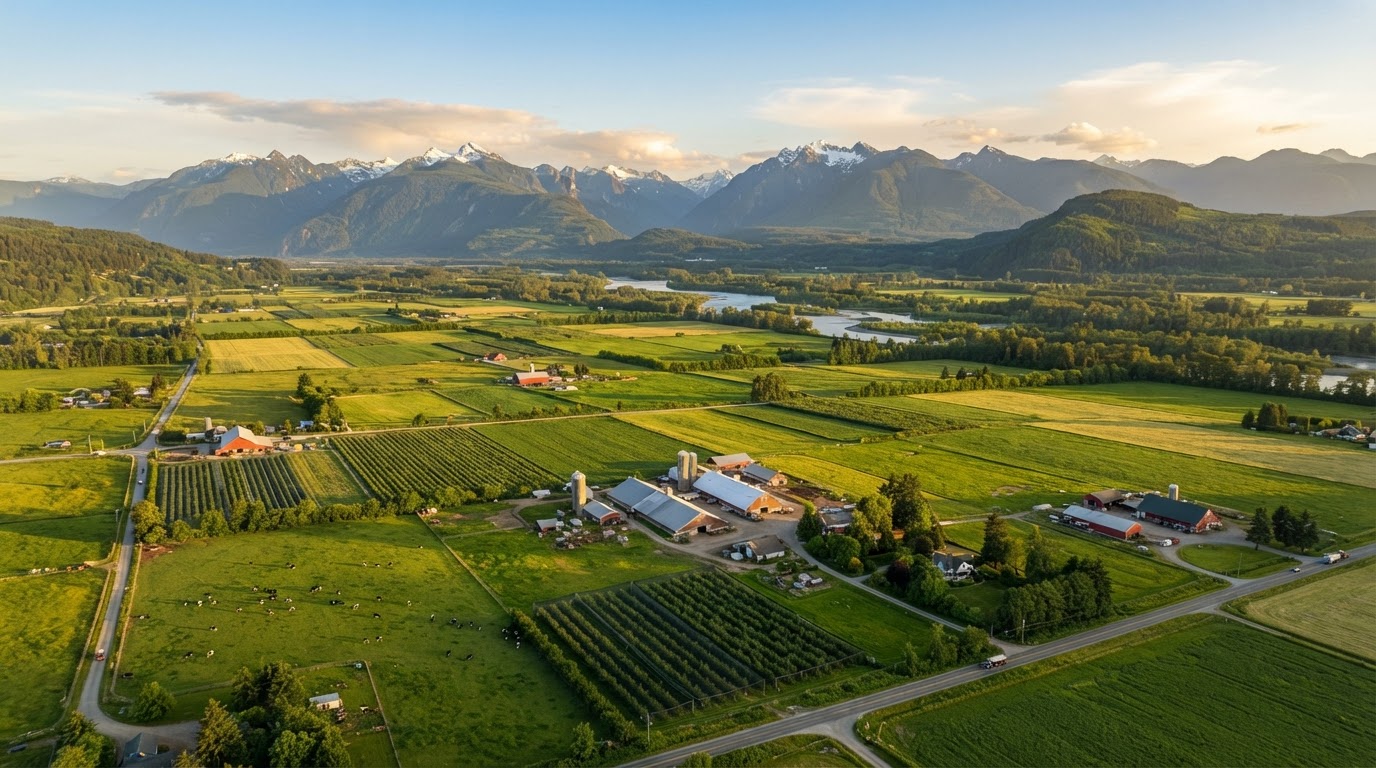
If you have ever tried to finance a residential purchase, you know the process: a down payment, an income letter, and a rate. Financing a farm — and especially ALR farmland — is a different transaction. The lender is underwriting not just you and the house, but the land, the water, the farm income, and whether the whole operation can service the debt. And on ALR land, there is an extra layer: the land-use restrictions that make the property farmland can also limit what a lender will finance and on what terms.
This article walks through the three main lending paths a BC farmland buyer typically considers — Farm Credit Canada (FCC), a chartered bank's agribusiness desk, and a vendor take-back mortgage — how they compare, what each one actually looks at, and how to pick the right structure for the ALR property you are buying. It builds on our Financing a Farm guide and the due diligence checklist — read those for the broader framework.
The short answer
There is no single 'best' lender for ALR farmland. The right path depends on the property's farm income, whether there is a residence, the soil and water, and what you can qualify for. A specialist agricultural lender like FCC often understands ALR land and farm income better, banks can be competitive when the property has strong residential value, and a vendor take-back can bridge a gap neither will fill. Most farmland deals are won or lost on which path fits the property — not on rate alone.
Why ALR land changes the financing math
A lender financing ALR farmland is looking at two things that a residential mortgage does not: the land's productive value and the restrictions that protect it. Because ALR land cannot be freely subdivided, developed, or used for non-farm purposes (see our ALR guide), the lender cannot assume the same exit options as a residential lot. If a borrower defaults, the lender has to resell the land as farmland, not as development land — and that shapes how much they will lend and against what.
The practical consequences for a buyer are real: the loan-to-value a lender will offer may be lower than on a residential property, the appraisal may weigh the soil, water and farm income alongside the buildings, and the lender may separate the residence from the farm portion of the property. Some lenders are simply more comfortable with ALR land than others, and that comfort — or lack of it — shows up in the terms.
Path 1 — Farm Credit Canada (FCC)
Farm Credit Canada is a federal Crown corporation that lends specifically to the agriculture sector. For a BC farmland buyer, FCC is often the lender most attuned to the way a farm actually works: they underwrite the operation and the land together, they are familiar with ALR properties, and they will look at projected farm income and agricultural assets in a way a residential mortgage desk will not.
Where FCC tends to fit well: properties where the value is genuinely in the farm — productive soil, licensed water, an operating or planned agricultural business — and where the borrower can show a farm plan or financials. FCC will typically look at the farm's income, the land's productive capacity, and the borrower's whole agricultural operation. The structure can be more flexible on amortization and on separating the farm from the residence than a standard residential mortgage.
What to prepare: a farm business plan, financial statements (or a realistic projection if you are buying to start farming), information on water licences, quotas, equipment and any leases, and details on the land's soil and improvements. The earlier you start this conversation — ideally before you make an offer — the smoother the timeline. See our Financing a Farm guide for what most lenders will ask for.
FCC is not always the cheapest — it is the most ag-literate
FCC's strength is not necessarily the lowest posted rate; it is that they understand farm income, ALR land and agricultural assets, and they will lend against the productive value of the operation. On a property where a residential lender sees 'a house on some land,' FCC sees a farm. For the right property that difference is what makes the deal financeable at all.
Path 2 — A chartered bank's agribusiness desk
Most major Canadian banks have an agribusiness or agricultural lending desk separate from their residential mortgage team. These lenders can be competitive on ALR farmland — particularly when the property includes a valuable residence or when the borrower's overall banking relationship is strong. They will underwrite the farm, but they typically weigh the residential and liquid-asset side more heavily than a pure agricultural lender.
Where a bank tends to fit well: properties where the residence carries a meaningful share of the value (a comfortable house on a smaller ALR parcel, for example), borrowers with strong non-farm income or liquid assets, and deals where rate and portability across a broader banking relationship matter. A bank may be faster to approve than a specialist agricultural lender when the loan is effectively a residential mortgage with some land attached.
Where a bank can struggle: large bare-land ALR purchases with little residential value, operations where the income is purely agricultural and seasonal, and properties where the productive value is the story but the borrower cannot show it in a format the bank's residential underwriting recognizes. In those cases a specialist lender or a vendor take-back may be the more realistic path.
Path 3 — A vendor take-back mortgage
A vendor take-back (VTB) is a mortgage the seller carries back to the buyer as part of the purchase price — the buyer pays the seller a down payment and then makes mortgage payments to the seller instead of (or in addition to) a bank. On ALR farmland, a VTB can be the difference between a deal closing and not closing, especially where institutional lenders will not finance the full value of a property whose worth is mostly in the land and the farm.
Where a VTB fits well: properties a bank or FCC will not fully finance (large bare-land ALR parcels, operations with thin conventional income), sellers motivated to close, and buyers who can document the farm plan but cannot yet show the income. A VTB can also be combined with institutional financing — a first mortgage from a lender for the portion they will advance, and a second from the seller for the gap.
What to watch: a VTB is a negotiated, unregulated contract, so the terms (rate, amortization, term, default, balloon) are entirely between you and the seller. The seller may also want security over the land, a personal guarantee, or a clause tying the mortgage to the farm continuing. Get legal advice before signing a VTB — the structure, the registration, and what happens on default all matter, and they vary deal to deal.
A VTB is a deal structure, not a free lunch
A vendor take-back can bridge a financing gap that no institutional lender will fill — but it is a negotiated contract with the seller, not a regulated mortgage. The rate, the term, the security and the default terms are all on the table. Treat it as seriously as a bank loan, document it properly, and get a lawyer to review it before you sign.
How the three paths compare for an ALR purchase
The right lender is rarely the one with the lowest headline rate — it is the one whose underwriting matches the property you are buying. Here is how the three paths line up against the questions that actually decide an ALR farmland deal:
| Question | FCC | Chartered bank | Vendor take-back |
|---|---|---|---|
| Understands ALR land-use limits | Usually well | Varies by desk | Seller sets terms |
| Weights farm income / farm plan | Heavily | Partly, with residential | Negotiated |
| Fits bare-land ALR with little house | Often | Sometimes | Often the only option |
| Fits strong-residence ALR parcel | Yes | Yes, competitive | Possible but often unneeded |
| Typical borrower prep | Farm plan + financials | Income + banking relationship | Down payment + legal review |
| Regulated / standardized terms | Yes | Yes | No — negotiated contract |
How to choose the right path for your purchase
The decision should follow the property, not the other way around. A bare-land ALR parcel with productive soil, licensed water and no house will usually fit a specialist agricultural lender or a vendor take-back far better than a residential mortgage desk. A comfortable house on a smaller ALR acreage with strong off-farm income may fit a bank's agribusiness desk just as well. And a property a lender will not fully advance may close only with a VTB bridging the gap.
- 1Start with the property, not the lender — identify whether the value is mostly in the farm, the residence, or the land itself (see our farm valuation guide).
- 2Match the lender to the income story — if the deal leans on farm income, talk to a specialist agricultural lender first; if it leans on off-farm income and residential value, a bank may be faster.
- 3Bring the farm plan early — a farm business plan, financial statements, water licence details and an honest projection of income move every conversation faster (see our Financing a Farm guide).
- 4Confirm what the lender will and will not finance on ALR land — ask explicitly about loan-to-value, whether the residence is separated, and what the appraisal will weigh.
- 5If no institutional lender will cover the gap, ask the seller about a VTB before walking away — a second mortgage or a full take-back can close a deal a bank cannot.
- 6Get legal advice on any VTB before signing — the structure, security and default terms are negotiated, not standard.
The bottom line for buyers
Financing ALR farmland is a different transaction than financing a home, and the lender you choose should be the one whose underwriting understands the property you are actually buying. Farm Credit Canada reads a farm the way a residential lender reads a house; a chartered bank's agribusiness desk can be competitive when the residence and the borrower's assets carry the deal; and a vendor take-back can bridge a gap neither institution will fill. The mistake to avoid is assuming one lender fits every ALR property — match the path to the land, bring the farm plan early, and get legal advice on any negotiated mortgage before you sign.
If you are financing a BC farm purchase and want help understanding which path fits the property you are buying, contact Gurjit for guidance grounded in the land's agricultural fundamentals and its realistic financing options.
Important: This information is educational only and is not legal, tax, financial or regulatory advice. ALR rules, water licensing, zoning and farm-classification requirements can change and depend on your specific property and circumstances. Always verify with the relevant BC authorities and qualified professionals before making decisions.
Frequently Asked Questions
- Can I get a normal residential mortgage on ALR farmland in BC?
- Sometimes, but not always. A lender financing ALR land has to underwrite the land and the farm, not just the house, and the ALR's restrictions on subdivision and development can limit the loan-to-value and the terms. On a smaller ALR parcel with a valuable residence and strong off-farm income, a residential or agribusiness mortgage may work. On larger bare-land ALR properties, a specialist agricultural lender like FCC or a vendor take-back is often more realistic. Ask the lender explicitly how they treat ALR land before you rely on their approval.
- What is Farm Credit Canada and is it better than a bank for buying a farm?
- Farm Credit Canada (FCC) is a federal Crown corporation that lends specifically to the agriculture sector. It is not necessarily 'better' than a bank in every case — its advantage is that it underwrites the farm operation and the land together, understands ALR land, and will weigh projected farm income and agricultural assets. For properties where the value is genuinely in the farm, FCC can be the lender that makes the deal financeable. For a property that is effectively a house on some land, a bank's agribusiness desk may be just as competitive and faster to close.
- What is a vendor take-back mortgage and when does it make sense for ALR land?
- A vendor take-back (VTB) is a mortgage the seller carries to the buyer as part of the purchase price. On ALR farmland, a VTB can make sense when an institutional lender will not fully finance the property — often because the value is mostly in the land and the farm rather than the residence, or the buyer cannot yet show the income a bank requires. It can also be combined with a first mortgage from a lender for the portion they will advance. A VTB is a negotiated, unregulated contract, so the rate, term, security and default terms are all between you and the seller — get legal advice before signing.
- Do I need a farm business plan to get an agricultural mortgage in BC?
- For a specialist agricultural lender like FCC, a farm plan and financial statements (or a realistic projection for a new operation) are commonly part of the underwriting, because the lender is weighing the operation's ability to service the debt. A chartered bank may place more weight on your overall income and banking relationship. In every case, the earlier you bring a clear, honest farm plan and financials, the faster and more productive the conversation. See our Financing a Farm guide for what to prepare.
- Does being in the ALR affect what a lender will finance?
- Yes. Because ALR land cannot be freely subdivided, developed, or used for non-farm purposes, a lender cannot assume the same resale or redevelopment options as a residential lot. That can mean a lower loan-to-value, an appraisal that weighs soil, water and farm income alongside the buildings, and a structure that separates the residence from the farm portion. Some lenders are more comfortable with ALR land than others — ask explicitly how they treat it before you build your financing around their approval.
Gurjit Ghai, REALTOR®
Personal Real Estate Corporation
Brokerage: Rexara Realty Inc.
Gurjit Ghai is a BC real estate professional specializing in agricultural land, ALR properties, and farm operations across British Columbia. He helps buyers and sellers navigate water rights, soil capability, farm classification, and the unique due diligence that farmland transactions require.