

Written by Gurjit Ghai, REALTOR®
Rexara Realty Inc.·Published: October 16, 2026·Market Insights
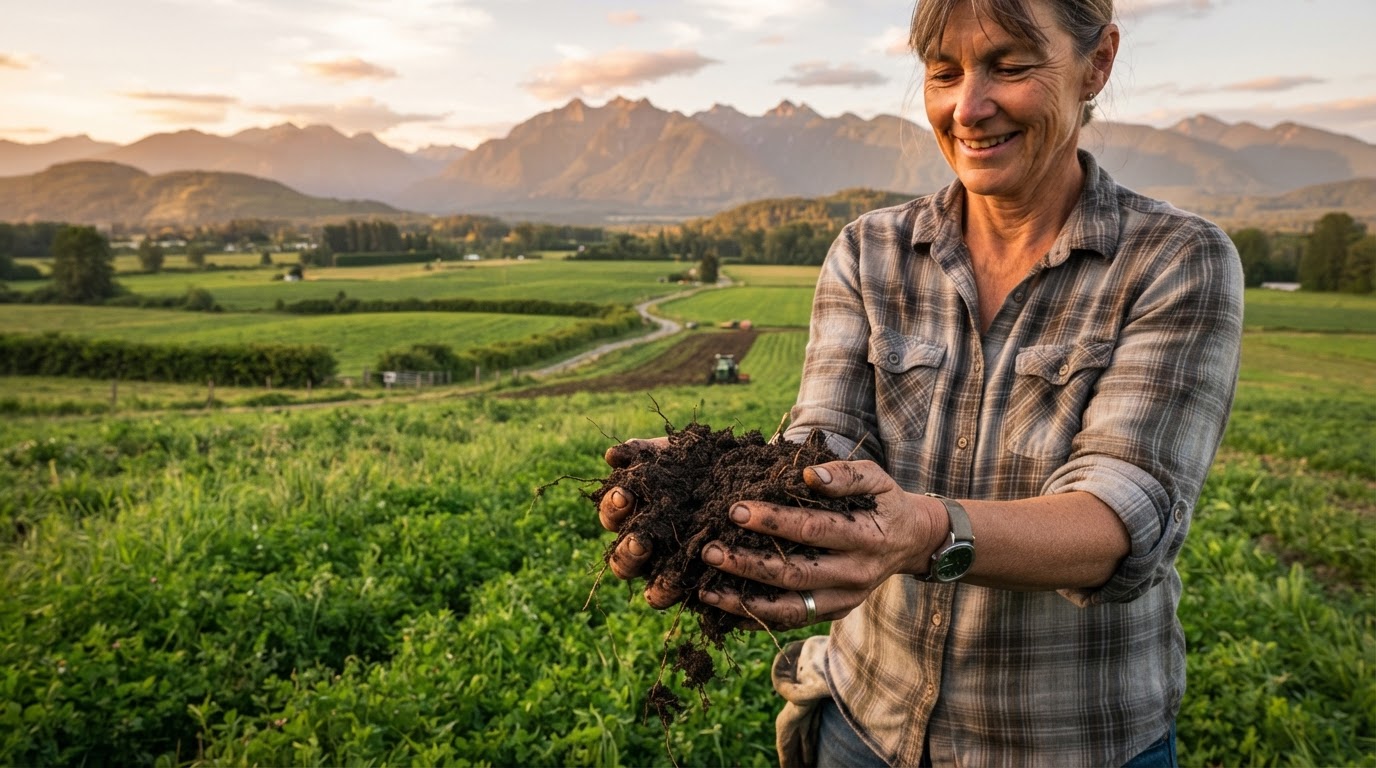
If you have been watching the agricultural real estate market, you have heard the pitch: regenerative farming practices can rebuild soil health, sequester carbon, and generate carbon credits that a landowner can sell — turning soil itself into a new revenue stream. For a buyer evaluating BC farmland, the natural question is whether this potential is real, whether it is already priced into asking prices, and what to verify before counting on it.
This article explains what regenerative agriculture and soil-carbon credits actually mean for a BC parcel, how they intersect with farmland valuation and due diligence, what a buyer should ask before an offer, and why the realistic answer is that soil health is a genuine long-term asset — but carbon credit revenue is still an emerging, verification-dependent opportunity, not a guaranteed income line. It builds on our farm valuation guide and the due diligence checklist — read those for the valuation framework and the pre-offer process.
The short answer
Regenerative practices — cover cropping, reduced tillage, rotational grazing, composting — can genuinely improve soil productivity and resilience on BC farmland, and that has real long-term value. Carbon credits are a separate, newer question: the market exists, but verified, saleable credits require baseline soil measurement, a registered methodology, a buyer for the credits, and time. A buyer should treat soil health as an asset to assess and carbon credits as a potential upside to verify — not as a guaranteed revenue stream.
What regenerative agriculture actually means on a BC parcel
Regenerative agriculture is not a single practice — it is a set of soil-management approaches aimed at improving soil organic matter, structure, biology and water-holding capacity. On BC farmland, the practices that matter most are:
- Cover cropping — planting non-cash crops between production cycles to keep living roots in the soil, reduce erosion and add organic matter.
- Reduced or no-till — minimizing soil disturbance to preserve soil structure and keep carbon underground.
- Rotational grazing — moving livestock across paddocks to prevent overgrazing and stimulate root growth in pasture.
- Compost and biochar amendments — adding organic material to build soil organic matter over time.
- Integrating livestock with cropping — using grazing animals as part of a crop rotation to cycle nutrients.
None of these are new — BC farmers have used cover crops and rotational grazing for generations. What is new is the framing: these practices are now being discussed as a way to sequester atmospheric carbon in soil, and that sequestration is what creates the potential for carbon credits. The agricultural value — better soil, better water retention, better yields over time — exists whether or not a carbon market ever pays for it.
How soil health connects to farmland value
Soil health has always been a factor in farmland value — it is part of why soil capability classes matter. What regenerative agriculture changes is the idea that soil health is not just a static inheritance (you got Class 2 soil or you did not) but something a farmer can actively improve. A parcel with degraded soil under regenerative management can, over years, become more productive and more resilient — and that improvement is a real asset.
For a buyer, this means two things. First, the current soil condition is not necessarily the permanent condition — a parcel with compacted, low-organic-matter soil may have significant improvement potential under the right management. Second, a parcel that has already been under regenerative practices for several years may have measurably better soil than its Canada Land Inventory class would suggest — and that improvement may not be fully reflected in the asking price.
What to ask the seller about soil management history
- What practices has the current owner used over the past 5–10 years — conventional tillage, reduced till, no-till, cover crops?
- Are there soil test records available — organic matter percentages, nutrient panels, biological assessments?
- Has the farm participated in any soil-health or carbon-monitoring program? If so, is there baseline data?
- What is the history of compost, manure or biochar applications?
- For pasture or ranch land — what is the grazing history and carrying capacity? See our ranch carrying capacity guide.
Carbon credits: the emerging revenue question
Soil-carbon credits are the part of the regenerative agriculture story that gets the most attention — and the part that requires the most skepticism from a buyer. The concept is straightforward in principle: if a farm's practices increase the amount of carbon stored in its soil, that increase can be quantified, verified and sold as a credit to a buyer who needs to offset emissions. In practice, generating saleable soil-carbon credits involves several non-trivial steps:
- 1Baseline measurement — establishing the current soil-carbon stock through sampling and lab analysis before any practice change.
- 2A registered methodology — using a recognized protocol that defines how carbon sequestration is measured and credited.
- 3Practice implementation and documentation — adopting the practices the methodology requires and keeping records.
- 4Verification — an independent third party confirms the sequestration is real and additional.
- 5A buyer — finding an entity willing to purchase the credits at a price that covers the measurement, verification and registration costs.
- 6Time — soil carbon accumulates slowly; meaningful, verifiable sequestration typically takes years, not months.
Why carbon credits are not a guaranteed income line
The soil-carbon credit market in Canada is still developing. Methodologies exist, but the standards, verification requirements and credit prices are not yet stable. The cost of baseline measurement and ongoing verification can exceed the revenue from credits on smaller parcels. A buyer should investigate whether a specific parcel is enrolled in a real program with verified credits — not assume that 'regenerative' on a listing means 'carbon revenue.'
BC-specific programs and what to verify
British Columbia and Canada have agricultural and climate programs that may touch on soil health, carbon sequestration or regenerative practices. These programs change — eligibility, funding and requirements shift with policy cycles. A buyer interested in carbon or regenerative agriculture revenue should:
- Check whether the parcel is enrolled in any current provincial or federal soil-health, carbon or conservation program — and whether that enrollment transfers with the land or expires.
- Verify whether any existing carbon credit contracts are attached to the property — these may be multi-year commitments that bind the new owner to specific practices.
- Ask whether the seller has signed any carbon-related agreements, easements or covenants that restrict land use in exchange for carbon or conservation payments.
- Confirm that any claimed program participation is documented — not just stated verbally.
This is part of standard due diligence — see our due diligence checklist — but it is especially important when carbon or conservation agreements are involved, because those agreements can run with the land and bind a future owner to management practices, reporting requirements or restrictions on development.
What a buyer should actually do
The practical approach for a buyer evaluating a BC parcel where regenerative agriculture or carbon credits are part of the value story:
- 1Treat soil health as a real asset — request soil test records, assess organic matter and structure, and consider whether the soil has improvement potential under your management.
- 2Separate the agricultural value from the carbon value — better soil has value whether or not carbon credits are ever sold. Do not pay a carbon premium unless there are verified, saleable credits.
- 3Verify any carbon or conservation program claims — ask for documentation, contracts and enrollment records. If the seller cannot produce them, treat the claim as aspirational, not contractual.
- 4Check for binding agreements — confirm there are no carbon contracts, easements or covenants that would restrict how you manage the land.
- 5Get professional advice — carbon credit contracts and conservation easements are legal commitments. A lawyer familiar with agricultural transactions should review any agreement before closing.
The realistic outlook for BC farmland buyers
Regenerative agriculture is not a fad — the soil-science behind it is sound, and the practices genuinely improve farmland productivity and resilience. For a BC buyer, that is the real opportunity: a parcel with improvement potential under regenerative management can become more productive and more valuable over time, and that improvement is something a buyer can create through management, not just inherit through soil class.
Carbon credits are a genuine but still-emerging opportunity. The market exists, methodologies are being developed, and some BC farms may eventually generate meaningful credit revenue. But for now, a buyer should treat carbon credits as a potential upside to investigate and verify — not as a guaranteed revenue stream to price into an offer. The value that is certain is the soil health itself; the carbon revenue is the part that still needs proof.
If you are evaluating a BC farm and want help understanding the soil, water and management history of a specific parcel, contact Gurjit — every evaluation includes a review of the property's agricultural fundamentals, not just the listing price.
Important: This information is educational only and is not legal, tax, financial or regulatory advice. ALR rules, water licensing, zoning and farm-classification requirements can change and depend on your specific property and circumstances. Always verify with the relevant BC authorities and qualified professionals before making decisions.
Frequently Asked Questions
- Can I sell carbon credits from my BC farmland?
- It is possible in principle, but generating saleable soil-carbon credits requires baseline soil measurement, a registered methodology, practice implementation, third-party verification and a buyer for the credits. The market in Canada is still developing, and the cost of measurement and verification can exceed credit revenue on smaller parcels. Treat carbon credits as a potential upside to investigate, not a guaranteed income stream.
- Do regenerative farming practices increase farmland value?
- Regenerative practices can improve soil health, productivity and resilience over time — and that improvement is a genuine asset. Whether it is reflected in a specific asking price depends on the parcel and the market. A buyer should assess soil health independently rather than assuming a 'regenerative' label automatically justifies a higher price.
- What should I check if a farm listing mentions carbon credits?
- Ask for documentation of any carbon program enrollment, existing credit contracts, and conservation easements or covenants attached to the property. Carbon contracts can bind a future owner to specific management practices. Have a lawyer review any agreement before closing.
- Are there BC government programs for regenerative agriculture?
- British Columbia and Canada have agricultural and climate programs that may relate to soil health and regenerative practices, but program eligibility, funding and requirements change with policy cycles. Verify current program details through official government sources rather than relying on listing claims.
Gurjit Ghai, REALTOR®
Personal Real Estate Corporation
Brokerage: Rexara Realty Inc.
Gurjit Ghai is a BC real estate professional specializing in agricultural land, ALR properties, and farm operations across British Columbia. He helps buyers and sellers navigate water rights, soil capability, farm classification, and the unique due diligence that farmland transactions require.