

Written by Gurjit Ghai, REALTOR®
Rexara Realty Inc.·Published: October 17, 2026·ALR & Zoning
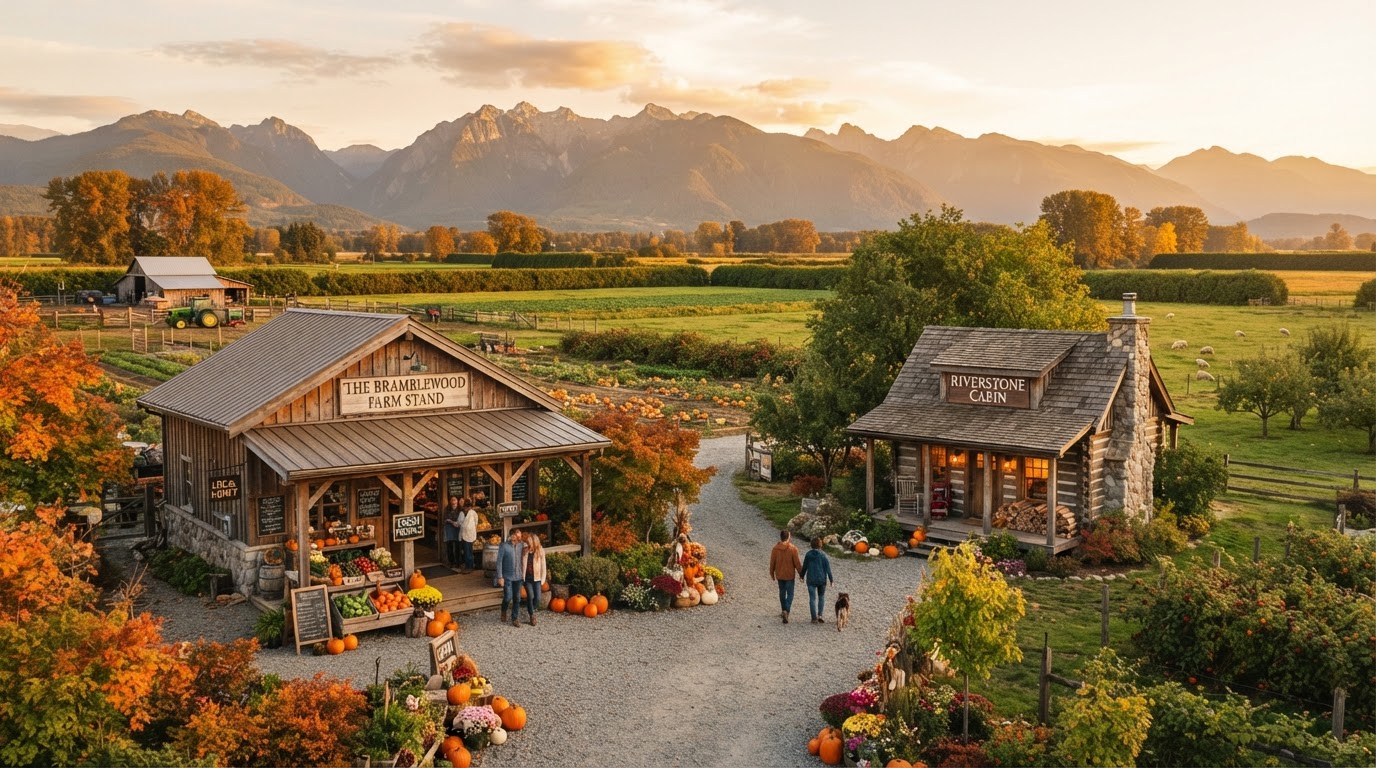
If you have toured BC farmland lately, you have seen the trend: farmgate stores selling produce and value-added products, farm-stay cabins listed on booking platforms, winery tasting rooms, and event venues hosting weddings in barns and fields. Agritourism is one of the most visible income-diversification strategies in BC agriculture, and it can genuinely add revenue to a working farm. But it is also one of the most misunderstood from a land-use perspective — because most BC farmland sits inside the Agricultural Land Reserve (ALR), and the ALR has specific rules about what agritourism activities are permitted, what require permission, and what are not allowed at all.
This article explains how agritourism works on BC farmland from a buyer's perspective — what the ALR permits, what it does not, how to evaluate a property's agritourism potential, and how to tell the difference between real income and aspirational income. It builds on our ALR guide and the due diligence checklist — read those for the land-use framework and the pre-offer process.
The short answer
Yes, agritourism is permitted on ALR land in BC — but only specific activities, and only when tied to an active farm operation. A farmgate store, farm-stay accommodation, tasting room or event venue is not automatically allowed just because the land is in the ALR. Some activities are permitted outright, some require approval or notification, and some are not permitted at all. Before you pay a premium for 'agritourism potential,' verify what the ALR and your local government actually allow on that specific parcel.
What counts as agritourism on ALR land?
The Agricultural Land Commission (ALC) distinguishes between agricultural activities — which are the primary permitted use of ALR land — and secondary, non-farm uses that may be allowed under certain conditions. Agritourism sits in this secondary category. The key principle is that agritourism must be connected to an active farm operation; it is not a standalone commercial use of farmland.
Common agritourism activities on BC farmland include:
- Farmgate retail — selling farm products directly to the public from a stand or store on the farm. This is generally the most straightforward agritourism use and is widely permitted when tied to products grown or raised on the farm.
- Value-added processing — making jam, cider, wine, cheese or other products from farm-grown inputs. Winery and cidery tasting rooms fall here, and they may involve both ALR rules and provincial liquor licensing.
- Farm-stay accommodation — short-term accommodation on a working farm, such as a cabin, room or glamping tent. The ALR has specific limits on the scale and type of accommodation permitted.
- Tours, tastings and on-farm events — guided farm tours, product tastings, and seasonal events like harvest festivals. Some are permitted; larger or more frequent events may require approval.
- Event venues — weddings, corporate events and private functions held on farmland. This is the most restricted category and frequently requires approval or is not permitted, depending on the activity and scale.
What the ALR permits, what requires permission, and what is not allowed
The ALR framework is not a single yes-or-no. It is a tiered system, and a buyer needs to understand which tier a specific activity falls into before assuming the income is available. The rules also interact with local government zoning — a use permitted by the ALR may still be restricted by your municipality or regional district, and vice versa. Always check both.
Permitted outright (when tied to a farm operation)
Some agritourism activities are permitted on ALR land without needing ALC approval, provided they meet the conditions — typically that the activity is ancillary to an active farm and sells or promotes products grown on the farm. Farmgate retail of farm products is the clearest example. But even permitted uses have conditions: building size, parking, signage and hours may be regulated. See our ALR land use guide for the framework.
Requires approval or notification
Other activities — larger farm-stay accommodation, certain processing facilities, and some event uses — require ALC approval, a notification process, or a local government permit before they can operate. The approval process can take time, and approval is not guaranteed. A property marketed with 'agritourism potential' for an activity that requires approval is not the same as a property where that activity is already permitted and operating.
Not permitted
Some commercial activities are not permitted on ALR land regardless of the farm operation — for example, uses that are purely commercial with no connection to agriculture, or event venues operating at a scale that goes beyond what the ALR allows. A buyer who assumes they can convert a farm into a full-time wedding venue may find that the use is not permitted, or that it requires an application with no guarantee of success. See our ALR exclusion guide for what it takes to remove land from the ALR entirely.
Permitted potential is not the same as permitted income
A property with 'agritourism potential' has a possible income stream — not a guaranteed one. The difference between a farmgate store that is already permitted and operating, and an event venue that would require an application with no guarantee of approval, is the difference between income you can underwrite and income you are speculating on. Price the property on what is permitted today, not what might be permitted after an application.
How to evaluate a property's agritourism potential
When you are evaluating a BC farm with agritourism in mind, the due diligence goes beyond the standard farm purchase checklist. You are buying not just the land and its agricultural capacity, but the regulatory pathway to a secondary income stream. Here is what to check:
- 1Confirm the ALR status and permitted uses — start with our ALR guide and verify the parcel's status and permitted uses through the ALC and your local government. Do not rely on the listing's description of 'agritourism potential.'
- 2Check local government zoning — a regional district or municipality may restrict agritourism uses even where the ALR permits them. Zoning bylaws, official community plans and agricultural area plans all matter. Confirm what the local government allows before assuming the income is available.
- 3Verify existing permits and approvals — if the property already operates an agritourism use (a farmgate store, a tasting room, a farm-stay), ask for the permits, licences and approvals. An operating use with permits is income you can underwrite; an operating use without permits is a compliance risk.
- 4Assess the infrastructure — agritourism often requires parking, washrooms, a retail or tasting space, signage and road access. Infrastructure that does not exist is a capital cost you must factor into the price. See our commercial greenhouse guide for how infrastructure drives value.
- 5Evaluate the market — a farmgate store needs customers, a farm-stay needs demand, and an event venue needs a booking pipeline. A property 45 minutes from a population centre has different agritourism economics than one 15 minutes away. Do not assume demand exists; verify it.
- 6Separate the farm income from the agritourism income — underwrite the property on its agricultural value first (see our farm valuation guide), then treat agritourism as a potential secondary stream. If the agritourism income disappears — because a permit is denied, demand falls, or rules change — the farm still needs to make sense on its own.
Wineries, cideries and tasting rooms: a special case
Winery and cidery tasting rooms are among the most established agritourism uses in BC, particularly in the Okanagan and the Fraser Valley. But they involve a layered regulatory picture: ALR land-use rules, provincial liquor licensing, and local government zoning all apply. A property with an existing, licensed winery is a different purchase than a property where you hope to establish one. See our vineyard valuation guide for what drives value in a winery property — the tasting room is part of that picture, but it is not the whole story.
Does agritourism add value to BC farmland?
It can — but the value it adds depends on whether the income is real and permitted, or aspirational and unproven. A property with a permitted, operating farmgate store generating steady retail revenue has a demonstrable income stream that supports a higher price. A property with 'event venue potential' that would require an application with no guarantee of approval does not — and paying a premium for that potential is speculating on an outcome you do not control.
The realistic approach is to underwrite the farm on its agricultural fundamentals — soil, water, buildings and location — and treat any agritourism income as a secondary, conditional stream. If the agritourism pathway is already permitted and operating, factor it in. If it requires approval, do not pay for it until the approval is in hand. See our acreage vs farm guide for how different property types carry different income profiles.
The bottom line for buyers
Agritourism is a genuine and growing income strategy on BC farmland, and for the right buyer on the right property it can meaningfully diversify revenue. But the ALR is not a free-for-all — what is permitted, what requires approval, and what is not allowed depends on the specific activity, the parcel, and the local government. A buyer who pays a premium for 'agritourism potential' without verifying the regulatory pathway is taking on a risk that may not pay off. Verify first, underwrite on what is real, and treat the rest as upside you have not yet earned.
If you are evaluating a BC farm with agritourism potential and want help understanding what the land and its secondary income streams are actually worth, contact Gurjit for a farm evaluation grounded in the property's agricultural fundamentals and its real regulatory pathway.
Important: This information is educational only and is not legal, tax, financial or regulatory advice. ALR rules, water licensing, zoning and farm-classification requirements can change and depend on your specific property and circumstances. Always verify with the relevant BC authorities and qualified professionals before making decisions.
Frequently Asked Questions
- Is agritourism allowed on ALR land in BC?
- Yes, but only specific activities and only when tied to an active farm operation. Some agritourism uses — like a farmgate store selling farm products — are permitted outright when conditions are met. Others — like larger farm-stay accommodation or event venues — require ALC approval or local government permits, and approval is not guaranteed. Some commercial uses are not permitted on ALR land at all. Always verify what is allowed on the specific parcel through the ALC and your local government.
- Can I run a wedding venue on BC farmland?
- Event venues are one of the most restricted agritourism categories on ALR land. Depending on the activity, scale and frequency, a wedding venue may require ALC approval, a local government permit, or may not be permitted at all. A property marketed with 'event venue potential' is not the same as a property where a venue is already permitted and operating. Do not pay a premium for event-venue income until the regulatory pathway is confirmed.
- Can I operate a farm-stay on ALR farmland?
- Farm-stay accommodation is permitted on ALR land under specific conditions, but there are limits on the scale and type of accommodation. Larger or more commercial short-term rental operations may require approval or may not be permitted. The rules also interact with local government zoning. Verify what is allowed on the specific parcel before assuming farm-stay income is available.
- Does agritourism increase the value of BC farmland?
- It can, but only when the income is real and permitted. A property with a permitted, operating farmgate store or tasting room has a demonstrable income stream that can support a higher price. A property with agritourism 'potential' that requires an application with no guarantee of approval does not have guaranteed income. Underwrite the farm on its agricultural value first, and treat agritourism as a conditional secondary stream until the regulatory pathway is confirmed.
- Do I need local government permits for agritourism even if the ALR allows it?
- Yes. The ALR and local government zoning operate in parallel. A use permitted by the ALR may still be restricted by your municipality or regional district through zoning bylaws, official community plans or agricultural area plans. A use allowed by local government may still require ALC approval. Always check both the ALC rules and your local government's zoning before assuming an agritourism use is available on a specific parcel.
Gurjit Ghai, REALTOR®
Personal Real Estate Corporation
Brokerage: Rexara Realty Inc.
Gurjit Ghai is a BC real estate professional specializing in agricultural land, ALR properties, and farm operations across British Columbia. He helps buyers and sellers navigate water rights, soil capability, farm classification, and the unique due diligence that farmland transactions require.